
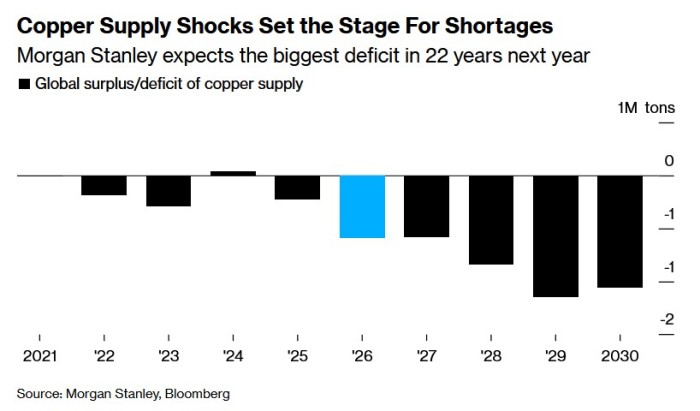
Mine disruptions bring forward the copper supply vulnerability as recycling falls behind demand
The year 2025 has proven to be fraught with accidents and disruptions at major copper mines. The Kamoa-Kakula complex in the Democratic Republic of Congo, one of the world’s top five copper projects, owned by China’s Zijin and Canada’s Ivanhoe, has encountered a series of technical difficulties, which began with seismic activity and escalated into complex infrastructure problems. Its 2025 copper production target was ultimately reduced by 28%, with losses this year alone estimated at 155,000 tonnes. Chilean Codelco’s output fell to a 20-year low in August following an accident at the El Teniente mine, where losses are estimated at 73,000 tonnes of copper over two years. Canada’s Teck Resources also revised downward its copper production forecast through 2028 due to ongoing problems at the Quebrada Blanca project.
The most significant disruption affecting the market balance occurred at Freeport-McMoRan’s Grasberg complex in Indonesia, where a force majeure was declared in September following an accident that resulted in a loss of up to 600,000 tonnes of copper in 2025 – 2026. Copper prices reached a new all-time high of above $11,200 per tonne in November amid supply disruptions and prospects for easing trade tensions between the US and China.
Mine disruptions this year, including problems at Grasberg, a slower recovery in Chile, and repeated protests in Peru, highlight structural supply constraints that are likely to persist until 2026, according to a UBS report. While refined copper production in China is expected to grow by 2.4% this year, overall global supply remains limited, according to Fitch Solutions. CRU notes that due to production disruptions, annual copper production this year is on track to decline for the first time since the COVID-19 pandemic.
Mining problems exacerbate the reduced availability of concentrate for processing and increase the importance of copper production from recycled materials (up to 20% of total supply currently comes from recycling), although supply here too will face constraints, McKinsey said.
Accident at Grasberg
An accident at one of the deposits of the Grasberg project in Indonesia’s New Guinea region is the most significant disruption to copper production to date. A sudden release of mud from a tailings dam into a drillers’ work area on September 8 killed seven people, leading to the immediate cessation of production.
Grasberg is Indonesia’s largest copper mine, and it accounts for approximately 3% of global production. Its annual production capacity ranges from 1.6 to 1.8 billion pounds of copper (approximately 726,000 to 816,000 tonnes). Grasberg is operated by PT Freeport Indonesia, in which the American company Freeport McMoRan owns 48.8% and the Indonesian government owns 51.2%. PT Freeport Indonesia accounts for approximately 43% of Freeport McMoRan’s annual copper output, while the damaged Grasberg Block Cave mine accounts for approximately 70% of PT Freeport Indonesia’s output.
Block Cave utilizes advanced underground mining techniques to access deep ore deposits. This method involves creating large underground voids where gravity allows the ore to flow downward for collection.
The tragic underground accident resulted in Freeport McMoRan’s third-quarter copper output falling by 13.2% year-on-year (or 139 million pounds). Gold output declined by 37% year-on-year to 287,000 ounces.
The company’s financial performance was supported by rising copper and gold prices: third-quarter revenue rose to $7 billion from $6.8 billion, despite a 6% year-on-year decline in copper sales and a 40% year-on-year decline in gold sales.
Freeport McMoRan’s copper production is forecast to fall to 635 million pounds in the fourth quarter of 2025, down 39% from the same period last year (1.04 billion pounds).
Due to Grasberg’s suspension, PT Freeport Indonesia’s copper output in 2025 will decline by 35% (approximately 578 million pounds, or 262,000 tonnes), compared to the initial forecast of 1.65 billion pounds (750,000 tonnes).
In 2026, Indonesia’s copper output may also decline by 35% compared to pre-incident estimates of approximately 1.7 billion pounds of copper and 1.6 million ounces of gold, the company announced immediately after the accident.
In late November, Freeport announced plans to partially restart underground operations at the damaged Grasberg Block Cave in the second quarter of 2026. Production at the undamaged Deep Mill Level Zone and Big Gossan mines has already resumed. A return to planned production is scheduled for July of next year. However, the company’s latest copper production forecast for 2026 is 10% lower than a September one, which was published immediately after the accident.
In its phased restart plan for 2026, PT Freeport Indonesia expects combined copper and gold production to be roughly in line with 2025 levels, amounting to approximately 1 billion pounds of copper and 900,000 ounces of gold. The company expects production to increase in 2026 and 2027, with average annual production in 2027 – 2029 expected to be approximately 1.6 billion pounds of copper and 1.3 million ounces of gold.
Historically, projects that faced similar mining accidents often take 12 – 18 months to return to pre-suspension output levels after gaining the approval to resume production. Following the tragedy, Indonesian authorities implemented enhanced safety protocols, requiring a comprehensive geological assessment before resuming operations.
Loss estimation
The cumulative loss of 591,000 tonnes of copper output between 2025 and 2026 due to the accident is equivalent to 2.6% of annual global production. Of this, 278,000 tonnes are expected to be lost in 2025, and another 313,000 tonnes in 2026. This reduction immediately creates price pressure and forces consumers to compete for available supplies from other sources.
By comparison, losses at Grasberg between September 2025 and December 2026 will exceed the 2026 production forecast for Chile’s Collahuasi mine, the third-largest copper mine in the world.
The most significant disruption to date was the Escondida strike in 2017 – 2018, which resulted in a loss of approximately 500,000 tonnes of production over several months.
Benchmark Copper Service estimates that the Grasberg accident could have a greater impact on refined copper supply than the recent outage at Kamoa-Kakula, highlighting the sector’s dependence on a small number of major mines. By 2025, the 20 largest copper mines will account for 36% of global supply.
Market swings to deficit
The Grasberg accident fundamentally alters the dynamics of the global copper market, shifting it from a state of balance, or even a slight surplus, to a significant supply deficit.
In its October report, the International Copper Study Group (ICSG) has revised the global copper production growth projection down to 1.4% from its April forecast of 2.3%, due to the Grasberg shutdown and the Kamoa-Kakula accident.
As a result, the ICSG lowered its projections for the copper market surplus in 2025 to 178,000 tonnes, from 289,000 tonnes in its April forecast. By the end of 2024, the global copper surplus was 71,000 tonnes. The cumulative impact of the unexpected production decline at the largest copper mines in 2025 will be fully felt next year, according to the ICSG report.
A deficit of approximately 150,000 tonnes is forecast for 2026, compared to a surplus of 209,000 tonnes expected in April. This shift toward deficit is explained by lower-than-expected refined copper production due to reduced copper concentrate supplies, as the concentrate shortage has been exacerbated, in part, by accidents at major mines.
The deficit is projected even with an expected slowdown in demand growth next year. Global refined copper consumption is forecast to increase by approximately 3% in 2025 to 28.1 million tonnes, while global consumption growth will slow to approximately 2.1% in 2026. This will primarily be due to a decline in consumption growth in China to 1%. The country accounts for up to 58% of global demand.
Overall, ICSG expects global consumption to continue to be supported by rising manufacturing activity in some key copper end-use sectors, continued demand from the energy transition, urbanisation, digitalisation (data centres) and the development of new semi-finished production capacity in India and several other countries.
In terms of production, its growth in 2025 was primarily driven by improved performance at the Kamoa mine (pre-accident) and the expansion project at the Oyu Tolgoi mine in Mongolia. In 2026, global copper production is expected to grow by 2.3%, driven by further mine commissioning in several countries, expected production growth in Chile, Peru, and Zambia, and a recovery in Indonesia.
Global refined copper production is expected to grow by approximately 3.4% to 28.3 million tonnes in 2025, primarily due to continued capacity expansion in China. In 2026, growth is expected to slow to 0.9% to 28.6 million tonnes.
For the first nine months of 2025, according to ICSG, global refined copper production increased by 4.3% year-on-year, reaching 21.347 million tonnes. The growth was driven by both primary production, which increased by 4%, and copper recycling, which was up 5.5%. Global consumption during this period increased by 5.5% to 21.25 million tonnes, leading to a global surplus of approximately 94,000 tonnes.
Forecasts
Morgan Stanley predicts that the global copper market will face its most severe deficit in more than 20 years in 2026.
In late October, analysts surveyed by Reuters raised their copper price forecasts for next year due to a series of mine outages that heightened fears of a shortage.
The consensus forecast of 30 analysts is for the average LME copper contract price to be $10,500 per tonne in 2026, up 7.2% from the $9,796 per tonne in the previous July survey.
According to analysts, the market recorded a deficit of 124,000 tonnes in 2025, compared to a surplus of 40,000 tonnes in the previous survey. Analysts expect the deficit to increase to 150,000 tonnes by 2026.
At the end of November, UBS analysts raised their estimate of the global copper deficit for 2025 to 230,000 tonnes, compared to the previously expected 53,000 tonnes, and to 407,000 tonnes in 2026, compared to 87,000 tonnes previously. They believe declining inventories and ongoing supply risks will help maintain a tight market environment.
UBS lowered its refined copper production growth forecast to 1.2% in 2025 and to 2.2% next year, citing deteriorating ore quality and operational challenges. Analysts expect global demand for the metal to increase by 2.8% in both in the current year and next, driven by the development of renewable energy, electric vehicles, and investment in power grids and data centers.
UBS expects copper prices to rise next year due to the reduced supply amid ongoing mine outages. The bank raised its copper price forecast for the end of the first quarter of 2026 by $750 to $11,500 per tonne. Expectations for June and September were raised by $1,000 to $12,000 per tonne and $12,500 per tonne, respectively. Experts also set a target price of $13,000 per tonne for December 2026. UBS experts believe any price decline will be short-lived and recommend maintaining long copper positions.
In October, Goldman Sachs analysts raised their copper price forecast for 2026 to $10,500 per tonne, up from the previously expected $10,000 per tonne, amid the Grasberg outages.
“The price is returning to a new range of $10,000 – $11,000 as resource constraints and structural demand growth from critical sectors of the economy set a new price ceiling from 2026 onwards,” the bank said in a statement.
Goldman experts expect that due to the Grasberg outage, global copper production will increase by only 0.2% in 2025, rather than the previously projected 0.8%. In 2026, it will increase by 1.9%, up from the previously projected 2.2%. As a result, Goldman Sachs analysts now forecast a global copper market deficit of 55,500 tonnes in 2025, rather than a surplus of 105,000 tons. Goldman still expects a slight supply surplus in 2026.
Recycling and its limitations
Increasing copper recycling may be key to solving the supply problem. According to ICSG estimates, recycled refined copper production will grow faster than primary refined copper output (from concentrates and hydrometallurgical production) in 2025 – by 4.5% versus 3%, respectively. In 2026, increased hydrometallurgical and recycled copper production will partially offset the limited supply of concentrate, although the growth rate of global refined copper production will slow down.
Currently, recycled copper accounts for approximately 20% of global supplies at around 5 million tonnes. By 2035, its share will increase to 25% at a CAGR of 4%, as volumes reach 14.1 million tonnes by 2050, according to Mckinsey estimates.
However, this growth will not fully offset the supply shortage, according to the Mckinsey report “Chasing Lost Copper: The Global Scrap Market and Its Role in Decarbonization.”
From 2025 to 2035, global demand for refined copper will grow by 2.4% annually, increasing from 29.5 million tonnes to 37.3 million tonnes. Copper supplies over these 10 years will grow by no more than 1.3% per year, according to the Mckinsey report, reaching 33.7 million tonnes by 2035. In particular, the volume of recycled copper output will increase from 5.6 million tonnes to 8.9 million tonnes by 2035. Therefore, refined copper supply by 2035 will be approximately 3.6 million tonnes below the projected demand.
Current scrap recycling capacity projections for 2035 suggest a recycling gap of over 1 million tonnes, and Mckinsey’s baseline scenario requires further capacity expansion.
Recycled copper supply is also limited: no more than 60% of post-consumer scrap will enter the global value chain by 2035; the rest is either lost, collected informally, or not collected at all, according to the report. Taking into account the recycling losses, the share of formally recycled and reused copper products further decreases to approximately 45% of the total copper content in scrap. Furthermore, copper is often only a partial component of the final product, requiring extraction, and large volumes of scrap may require refining or further recycling due to impurities.
Analysts at Mckinsey believe that copper producers need to consider partnerships and investments in the scrap collection and recycling value chain in order to access the growing (and partially untapped) recycled supply. As these value chains mature, the competition for scrap will intensify, making it crucial to be proactive, the report states.
In addition to ensuring copper supply security, producing copper from scrap eliminates the emissions associated with primary copper production. Cathodes with 100% recycled content emit approximately 85% less carbon than cathodes produced primarily from concentrates, Mckinsey notes.

Leave a Reply